By Jose Corpas
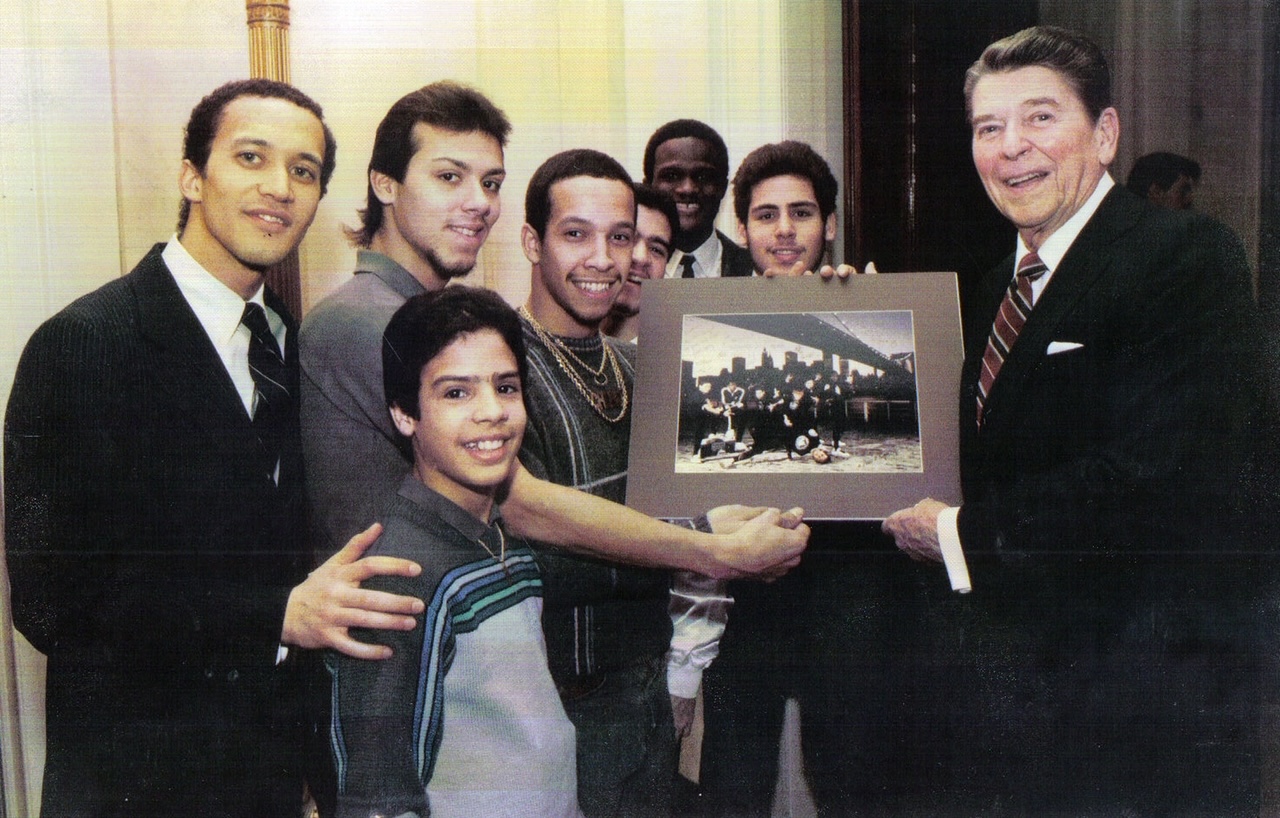
“We, the New York City Breakers, see the Olympic Games as our future.” That declaration, written and signed on January 15, 1984, by all the NYC Breakers, was met with “blowback,” within the “Breakin” community, according to London Reyes. “They were traditionalists, they wanted to keep it pure,” he explained.
- READ MORE: The Bronx was burning… and Breaking
Better known as B-Boy London, he credits NYC Breakers leader Chino Lopez as being the visionary who first saw the direction that Breakin could go. On August 9th and 10th, more than forty years after their declaration, Lopez and the others will see their prophecy come true.
Admittedly, there was a time during the late 1980s when B-Boy London thought Breakin had seen its final days. “It almost died out, around 1985-1986. By 1989, it was played out. People used to make fun of us – they’d say, ‘Man you guys are still doing that.’”
Before it became played out in New York, young Neils Robitzky was listening to the radio in his home in Eutin, Germany. An interview followed discussing an “incredible gymnastic dance” that was being performed in New York. A few years later, Robitzki and a couple of friends flew to New York, hoping to become a part of the Breakin culture.
“They thought New York was going to look like a scene from Beat Street, the movie.” Instead, they became the scene.
Teaming up with the remaining few breakers in the city who were performing regularly, Robitzki, now known as B-Boy Storm injected new life into the Breakin scene. “At that time, he was the best in the world,” says B-Boy London.
While dancers in Germany and other parts of Europe had adopted the look, music, and dance moves of early New York, dancers in Miami were also taking break dancing to new levels. What started out in the Bronx, a branch of Hip-Hop alongside rapping, DJ’ing, and graffiti, breakin had taken on a new and separate life.
“People fell in love with the B-Boy culture more than the Hip-Hop culture,” says B-Boy London.
No longer limited to street battles or presentations, Breakin was entering the competitive dance realm. In Europe, and in Miami, some were ahead of the game.
“I wanted to incorporate a points system similar to what they had in martial arts competitions,” says Speedy Legs, a prominent Miami B-Boy. “It had to have a scoring system. I knew it could be an Olympic sport.” Among the first to organize a points system, Speedy Legs began implementing a system that would help land Breakin in the Olympics.

Still, it wasn’t until 2014 that the Olympic dreams began to become a reality. In an interview with WHYY News’ Morning Edition, Zack Slusser, vice president of DanceSport Breaking at USA Dance and Breaking for Gold USA, explained how it became an Olympic sport and how it ended up under the unlikely banner of ballroom dancing.
“The IOC has a very formal process for governance over all the sports that are managed under the IOC’s platform. Breakin as a global entity or as a global community has no global infrastructure. There is no organization that standardizes how we’re going to do breaking here in this country or going to do it all together. It doesn’t exist…the only international federation that was accredited that had an assemblance of relating to dance was the ballroom organization.”
After an appearance at the 2018 Youth Olympics, it earned its way into the 2024 Games.
Unfortunately, it has already been decided to leave Breakin out of the 2028 Games.
“Why? What happened?” Asks B-Boy London.
With an uncertain future after the games, a few of the industry’s key players have a few ideas up their sleeves.
In Miami, USA Breakin aims to create a league where the best from each city competes against each other like they do in the NBA. B-Boy Speedy Legs, born Ricardo Fernandez Jr. in Cuba, is credited “for creating the blueprint for competitive breaking competitions in the United States,” according to his bio on USA Breakin. Along with Miami DJ, Felix Sama and others at USA Breakin, the hope is to have the league running by 2025.
B-Boy London agrees. “It could work as long as they have uniform rules in each city and have a national oversight like the NBA.” But he has a different idea for the future of the sport. “It should a Division 1 sport and students should qualify for scholarships.” Every Ivy League school has a Breakin program, he pointed out. There’s the Yale Breakers, the Harvard Breakers. “It could be like Lacrosse.”

For now, though, all eyes will be on the 2024 Olympics in Paris. “It’s the most incredible and dynamic sport in the world,” says B-Boy London. “There’s flipping, jumping, improvising, and you have to do it to the music.” Preparation is like that of any athletic sport. There’s physical preparation, mental, and even diet. When we were doing it, we didn’t even stretch!” Before hanging up the phone, B-Boy London added, “You’re going to see things you never saw before.”
Forty years ago, one of his other predictions came true.


